September 12, 2023By: Andrey Yushkov
Property taxes are the primary tool for financing local governments and generate a significant share of state and local revenues. In fiscal year 2020, property taxes comprised 32.2 percent of total state and local tax collections in the United States, more than any other source of tax revenue. Local governments rely heavily on property taxes to fund schools, roads, police departments, fire and emergency medical services, and other services associated with residency and property ownership. Property taxes accounted for 72.2 percent of local tax collections in fiscal year 2020.
Because property taxes are locally levied, providing a useful state-level comparison can be difficult. So, in an effort to present a multifaceted view, today’s blog features two maps focused on property taxes. The first looks at median property tax bills in each county in the United States, and the second compares effective property tax rates across states.
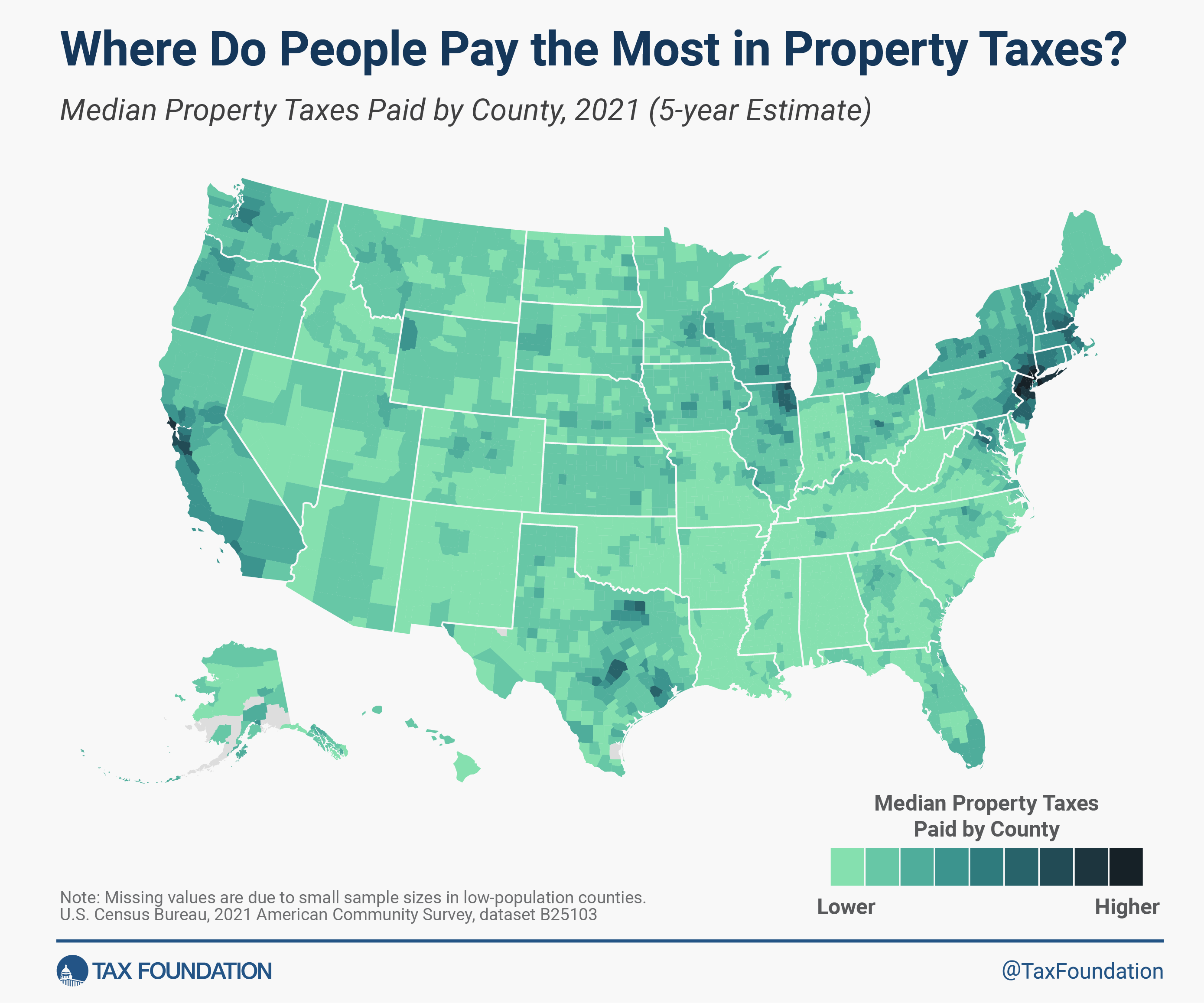
Median property taxes paid vary widely across (and within) the 50 states. The average level of property taxes paid in 2021 across the United States was $1,682. The lowest property tax bills in the country are in seven counties or county-equivalents with median property taxes of less than $200 a year:
- Alaska: Northwest Arctic Borough and the Kusilvak Census Area*
- Louisiana: Allen, Avoyelles, East Carroll, and West Carroll
- Alabama: Choctaw
(*Significant parts of Alaska have no property taxes, though most of these areas have such small populations that they are excluded from federal surveys.)
The next-lowest median property taxes are found in Madison Parish, Louisiana ($215); Bienville Parish, Louisiana ($220); Sioux County, North Dakota ($223); Lamar County, Alabama ($234); and McDowell County, West Virginia ($237).
The 11 counties with the highest median property tax payments all have bills exceeding $10,000:
- New Jersey: Bergen, Essex, Hunterdon, Morris, Passaic, and Union Counties
- New York: Nassau, New York, Rockland, and Westchester Counties
- Virginia: Falls Church
All but Falls Church are near New York City, as are the next highest, Suffolk County ($9,911) and Putnam County ($9,855), New York.
Where Do People Pay the Most in Property Taxes?
Median Property Taxes Paid by County, 2021 (5-year estimate)
Note: Missing values are due to small sample sizes in low-population counties. This interactive map is more accessible when viewed on larger screens.
Source: U.S. Census Bureau, 2021 American Community Survey, dataset B25103
LAUNCH FULL INTERACTIVE MAP ACCESS SHAREABLE MAP
Where Do People Pay the Most in Property Taxes?
Median Property Taxes Paid by County, 2021 (5-year estimate)

PREVIOUSNEXTNote: Missing values are due to small sample sizes in low-population counties. This interactive map is more accessible when viewed on larger screens.
Source: U.S. Census Bureau, 2021 American Community Survey, dataset B25103
Property tax payments also vary within states. In some states, typically those with low property tax burdens, this variation is not high. In Alabama, for instance, median property taxes range from below $200 in Choctaw County to $1,167 in Shelby County (part of the Birmingham–Hoover metropolitan area), with an average tax bill of $449. In Virginia, in contrast, median property taxes range from $378 in Buchanan County to more than $10,000 in Falls Church (part of the Washington metropolitan area), with an average tax bill of $1,764.
Another feature of property taxes is that higher median payments tend to be concentrated in urban areas. Median property taxes paid in New York County, San Francisco, Chicago (Cook County), and Miami (Miami-Dade County) are two to three times higher than their state’s average. This is partially explained by the prevalence of above-average home prices in urban centers. Because property taxes are assessed as a percentage of home values, it follows that higher property taxes are paid in places with higher housing prices. However, because millages—the amount of tax per thousand dollars of value—can be adjusted to generate the necessary revenue from a given property tax base, the higher payments also reflect an overall higher cost of government—and commensurately higher taxes—in these areas.
While no taxpayers in high-tax jurisdictions will be celebrating their yearly payments, it’s worth noting that property taxes are largely rooted in the benefit principle of taxation: the people paying the property tax bills are most often the ones benefiting from the services (think K-12 education or local parks). As argued by Joan Youngman in her book A Good Tax, the well-designed property tax, despite being the target of frequent political attacks, can be considered a good tax since it is usually visible, transparent, simple, and stable, satisfying most of the principles of sound tax policy.
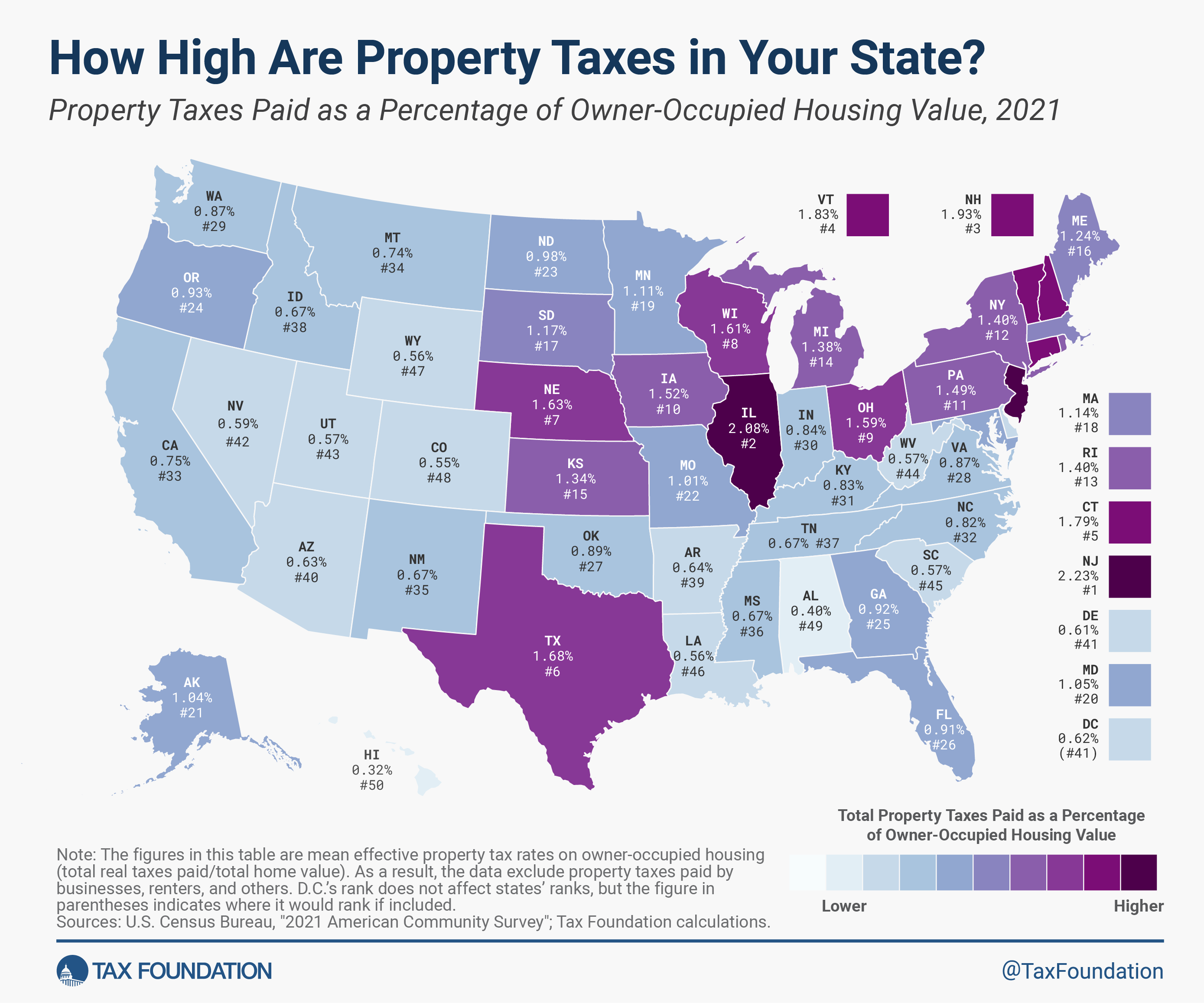
Because the dollar value of property tax bills often fluctuates with housing prices, it can be difficult to use this measure to make comparisons between states. Further complicating matters, rates don’t mean the same thing from state to state, or even county to county, because the millage is often imposed only on a percentage of actual property value, as discussed below. However, one way to compare is to look at effective tax rates on owner-occupied housing—the average amount of residential property taxes actually paid, expressed as a percentage of home value.
 MichaelGouldGroup.Com
You must be logged in to post a comment.