As the economic fallout of the pandemic continues to unfold, banks are rushing to close credit card accounts or slash credit limits to curb their risk.

“These are really big numbers,” said Matt Schulz, chief industry analyst at CompareCards. “It means that an awful lot of Americans had one of their financial security nets taken out from under them in one of the most difficult economic times in American history.”

1 in 5 cardholders saw a credit decrease of at least $5,000

While most credit limits were reduced by $1,000 or less, more than 1 in 5 cardholders said their limits were slashed by at least $5,000.

“Folks who saw the biggest credit limit reduction were high-income folks,” Schulz said. “They’re more susceptible to credit limit cuts, simply because they will be the most likely to have high credit limits in the first place.”

Americans making more than $100,000 were the most likely to have their credit limit cut. Two in 5 reported that happened to them. 

d
Millennials are most likely to have had credit limits slashed and cards closed. Source: CompareCards

Young millennials were the most likely to be affected among the generations, the report found. Four in 9 young millennials, currently between 24 and 31, had a card closed, while 5 in 9 had their credit limit reduced. 

“We know an awful lot of millennials got very enthusiastic about credit card rewards over the last few years,” Schulz said. “So they may have a few cards in their wallet that they haven’t used in a while.”

Read more: What to do if you’re denied a new credit card

A reduced credit limit likely will ding your credit score. That’s because it increases your utilization rate — by lowering the amount of available credit that you have— the second-most important factor in credit scoring.

“It doesn’t take much to really impact your utilization rate, and potentially really hurt your credit score,” Schulz said.

Denitsa is a writer for Yahoo Finance and Cashay, a new personal finance website. Follow her on Twitter @denitsa_tsekova.

Read more:

As the economic fallout of the pandemic continues to unfold, banks are rushing to close credit card accounts or slash credit limits to curb their risk.

One in 4 Americans with credit cards said they had an account involuntarily shut down from mid-May to mid-July, while 1 in 3 said their credit limit was reduced, according to a new report from CompareCards.com that surveyed 1,003 credit cardholders.

This follows a similar rate of reductions in April and comes as many Americans battle joblessness and uncertain economic futures, but now with reduced access to credit.

“This is, in a lot of ways, a much bigger issue today than it was in the Great Recession,” Schulz said. “It makes sense that banks are taking an even harder line with lending because there’s so much that they don’t know, and they’re so nervous about risk.”

"Let Me Find Your Next Property"
Are You Ready?

Microsoft-owned LinkedIn to cut 960 jobs, or 6% of its work force due to pandemic – MarketWatch

Job networking site LinkedIn is cutting about 960 jobs, or 6% of its work force, as it moves to align the business with the new COVID-19 world. In a message…
— Read on www.marketwatch.com/story/microsoft-owned-linkedin-to-cut-960-jobs-or-6-of-its-work-force-due-to-pandemic-2020-07-21

1 Smart Reason to Claim Social Security Early if You Lose Your Job

More layoffs may be on the way, and Social Security could help keep your retirement on track.
— Read on www.fool.com/retirement/2020/07/17/1-smart-reason-to-claim-social-security-early-if-y.aspx

Steer Clear of “Steering”

July 10, 2020Working With BuyersFair HousingFair Housing Act

“Steering” is the practice of influencing a buyer’s choice of communities based upon one of the protected characteristics under the Fair Housing Act, which are race, color, religion, gender, disability, familial status, or national origin. Steering occurs, for example, when real estate agents do not tell buyers about available properties that meet their criteria, or express views about communities, with the purpose of directing buyers away from or towards certain neighborhoods due to their race or other protected characteristic. If a client requests a “nice,” “good,” or “safe” neighborhood, a real estate professional could unintentionally steer a client by excluding certain areas based on his or her own perceptions of what those terms means.

Despite being illegal under the Fair Housing Act, a recent investigation conducted by the newspaper Newsday has shown that steering continues to be pervasive. Newsday had real estate agents show properties to one white tester and one minority tester (either African American, Hispanic, or Asian) with similar housing needs and financial capabilities. The investigation revealed that in 24% of cases, the real estate agents directed the white tester into differing communities from the minority testers, suggesting evidence of steering.

The following best practices will help you steer clear of steering:

  • Provide clients with listings based on their objective criteria alone.
  • When a client uses vague terms such as “nice,” “good,” or “safe,” ask impartial questions to clarify their criteria, such as property features and price point.
  • Only communicate objective information about neighborhoods and direct clients to third-party sources with neighborhood-specific information.
  • Learn to pay attention to your unconscious biases. When evaluating what a client objectively wants, ask yourself why you have eliminated certain areas, if you have.
Choose Your Home…

What is 1035 exchange ?

www.thinkadvisor.com/2016/03/10/avoiding-the-tax-traps-of-1035-exchanges/

Dow up 450 points on gains for shares of Caterpillar, UnitedHealth

DOW UPDATE Shares of Caterpillar and UnitedHealth are seeing strong returns Tuesday afternoon, propelling the Dow Jones Industrial Average rally. Shares of Caterpillar (CAT) and UnitedHealth (UNH) have contributed to the index’s intraday rally, as the Dow (DJIA) was most recently trading 450 points (1.
— Read on finance.yahoo.com/m/e95b8460-f9b7-38f6-8c0d-f950d20b8c25/dow-up-450-points-on-gains.html

What you need to know if you are thinking about using home equity to cover expenses during the coronavirus pandemic

By Davida Farrar – MAY 14, 2020

We recently took action to make it easier for consumers with urgent financial needs due to the coronavirus pandemic to obtain access to mortgage credit more quickly. We issued an interpretive rule to clarify that, in certain circumstances, consumers may waive or modify certain waiting periods in mortgage transactions when facing a bona fide (good faith) personal financial emergency due to the coronavirus pandemic. This could help you to more quickly close on some mortgage loans. The rule clarifies:

  • Waived waiting periods. You may be able to waive certain waiting periods that are generally required between the time you receive important disclosures about the mortgage loan you are considering and before closing on the mortgage.
  • Waiver of right to rescind. You may waive your right to rescind—or right to cancel the loan—for certain types of non-purchase transactions, like refinances, home equity loans and reverse mortgages. This is generally a three-business day period.

This rule is intended to help consumers who have a need to obtain funds due to the COVID-19 pandemic prior to the end of an applicable waiting period. While we expect this to be a limited number of consumers—those seeking cash-out refinancing who can demonstrate an acute, near-term financial need during this challenging time—we wanted to make sure to share information about what it means to waive these waiting periods. Additionally, here are some tips and cautions for anyone thinking about using home equity to cover financial emergencies during this time.

Mortgage basics

For closed end mortgage loans, including a refinance or a home equity loan, the lender generally has to provide you with two important disclosures a certain number of days before you close on the loan. These time periods are known as “waiting periods.”

I can help!

Loan Estimate

When you apply for the loan, the lender has to give a Loan Estimate, which describes important information about your loan offer. The lender has to give you the Loan Estimate within three business days of the lender’s receipt of loan application and at least seven business days before you close on the mortgage loan.

Closing Disclosure

If you decide to proceed with the loan, the lender has to give you a Closing Disclosure, which provides final details on the loan you have selected. The lender must give you the Closing Disclosure at least three business days before you close.

What it means to waive a disclosure waiting period

These waiting periods can be very helpful in giving you time to make sure the loan terms are right for you and seek the advice of family members, friends, or professionals like housing counselors or lawyers. These waiting periods collectively:

  • Give you time to make sure you understand your loan offer
  • Give you time to compare offers to find the best deal
  • Let you compare your final terms and costs to those estimated in your offer
  • Give you time to ask your lender questions before you close.

The Bureau’s new rule clarifies that you may be able to waive a waiting period due to a bona fide personal financial emergency related to the pandemic, if the emergency requires you to receive the funds more quickly than the waiting period would allow. To do so, you must:

  • Give the lender your own brief written statement—pre-printed forms are not allowed—describing the emergency which identifies a financial need that is due to the COVID-19 pandemic and clearly stating that you are waiving or modifying the waiting period.
  • Sign and date the statement yourself, along with anyone else who is primarily obligated on the loan.

Whether or not you waive a waiting period, make sure you understand and can afford your loan terms and you are comfortable committing to the loan. Read here for more tips on getting ready to close on your mortgage .

What it means to waive your right to rescind

The right of rescission is the right to cancel certain types of mortgage transactions. You have a right of rescission for most non-purchase money mortgages, or mortgages that are not being used to buy a home. This includes refinances, home equity loans, and reverse mortgages. The right generally gives you three business days to cancel the mortgage agreement. If you waive your right to rescind, you waive the right you would have otherwise had to cancel the transaction for any reason or no reason at all—unless there is proof of fraud.

The Bureau’s new rule clarifies that you may be able to waive your right of rescission due to a bona fide personal financial emergency related to the pandemic. To do so, you must:

  • Give the lender your own brief written statement—pre-printed forms are not allowed—describing the emergency which identifies a financial need that is due to the COVID-19 pandemic and clearly stating that you are waiving your right to rescind.
  • Sign and date the statement yourself, along with anyone else who shares in the ownership of the home.

Before you tap your home equity, evaluate all your options

If you are considering refinancing your mortgage  or taking out a home equity loan to deal with increased expenses, a loss of income, or for any other reason, it’s important to look at all of your options. While using home equity may be a good option for some consumers, it may put others at increased financial risk down the road. If your finances don’t recover as quickly as expected or your home loses value and you have difficulty paying your loan, you could lose your home to foreclosure.

Where can I get additional help?

If you need help understanding your options, you can reach out to a professional to help you with your specific situation.

HUD-Approved Housing Counselors. The U.S. Department of Housing and Urban Development (HUD)-approved housing counselors can discuss options with you if you’re having trouble paying your mortgage loan or reverse mortgage loan. This may also include forbearance or a modified payment program.

Credit Counselors. Reputable credit counseling organizations are generally non-profit organizations that can advise you on your money and debts, and help you with a budget. Some may also help you negotiate with creditors. There are specific questions to ask to help you find a credit counseling organization to work with.

Lawyers. If you need a lawyer, there may be resources to assist you through your local bar association, legal aid, or if you are a servicemember, your local Legal Assistance Office .

Other resources

You are not alone, as many people are facing financial challenges during this time and may be considering different ways to access additional funds and financial support. We are providing consumers with tools and resources to protect their finances and financial well-being during this difficult time.

Visit our Coronavirus resources, including our Guide to coronavirus mortgage relief optionstools for when you can’t pay your bills, and dealing with debt

See our mortgage process guide and tips, including refinance

Understand how a reverse mortgage works

ARE YOU COVERED?

Are You Covered?

Homeowners insurance also Covers Four More Things:

I. Your outbuildings, landscaping, and hardscaping. If you have outbuildings (like a barn), landscaping, or hardscaping (like fences), your homeowner’s policy most likely covers those for up to 10% of your policy amount (5% for plants).

For example, if you have $100,000 in homeowners insurance and someone drives into your fence, the policy would cover 10%, or $10,000 in repairs.

Sometimes policies exclude damage to outbuildings, landscaping, or hardscaping caused by a particular peril (like wind).

II. Damage or loss of your personal belongings. Your homeowner’s policy covers your family’s belongings, even when you take them out of the house. If your child heads to college with a laptop and it’s stolen, that’s probably covered by your homeowner’s insurance policy.

A home insurance policy covers a lot of your personal belongings, but not necessarily everything.

You’ll need additional insurance if you have many expensive items like jewelry, furs, or antiques. 
Policies will either state that your personal belongings are insured for replacement cost or cash value.

Replacement cost means that the insurance company will pay the full cost of replacing an item (such as the laptop mentioned above, or a sofa damaged in a fire) once you show a receipt. Cash value means the insurance company will issue you a check for the amount that the laptop or sofa would have been worth when it was stolen or destroyed.

III. Remember your Additional Living Expenses will have limits. You are still on a budget. If you exceed that budget you may have to come out of pocket. Your policy will have limits on how long you stay and how much you can spend.

IV. Injuries or accidents at your house. Homeowner’s insurance coverage includes liability – meaning it covers you when you or your family members cause injuries or damage. This coverage also pays when your dog bites someone (medical payments) or someone falls and injures themselves.

 We’re getting closer to storm season. 2019 was devastating. Check with your agent and make sure you are prepared.

Remember; “It’s A Numbers Game”!!!

Michael Gould

Property & Casualty

Black families pay significantly higher property taxes than white families, new analysis shows

Unfair property assessments lead to widespread over-taxation of black Americans’ homes

A national reckoning with racism, combined with the economic damage wrought by the pandemic, is prompting some state and local officials to take a closer look at an issue that has long bedeviled Black homeowners: inflated property tax assessments.

For decades, white tax assessors placed a heavier tax burden on Black residents by intentionally overvaluing their property. In the Jim Crow South, officials used property taxes to punish Black homeowners and churches that boycotted white businesses or hosted civil rights meetings.

Several recent studies and investigations show that, racially motivated or not, many tax assessors still routinely saddle Black and minority residents with property tax bills that are too high given the value of their homes.

With millions out of work and the economy sputtering, some cities and states have approved temporary property tax breaks to help people avoid tax delinquencies and foreclosures. Others, prompted by the recent protests, are taking a deeper look at the racial inequities baked into system.

“People are starting to think about this,” said Paul Bidanset, project manager at the International Association of Assessing Officers, a professional organization that develops guidelines used around the world. “Assessors have tools to measure any inequities in their assessment and correct them.”

Many historians and housing experts say the conversation is long overdue.

“We’ve seen these moments of crisis bring structural changes,” Andrew Kahrl, associate professor of history and African American studies at the University of Virginia, said in a phone interview. “What those will be, who knows?

“These are forms of structural racism that are very invisible,” he said. “It’s subtle. It’s insidious and happens in ways the victims themselves aren’t aware of.” 

Because property taxes are assessed locally, Kahrl said, there hasn’t been a national movement for change. And the job of demystifying the opaque assessment process usually falls to city auditors and local reporters.

Furthermore, any effort to lighten the property tax burden on minority homeowners might run into resistance from local officials desperate to recoup tax revenue vaporized by the downturn.STATELINE STORY October 3, 2019Talk of Reparations for Slavery Moves to State Capitols

Cornell Brooks, a professor at the Harvard Kennedy School of Government and former president of the NAACP, noted that in the aftermath of the Great Recession, many localities became more aggressive about seizing and selling properties with unpaid taxes.

“All this points to the broader problem: Local governments for decades have been starved for revenue,” Brooks said in an interview. “And the way they’ve responded has made the problem worse for the most disadvantaged.”
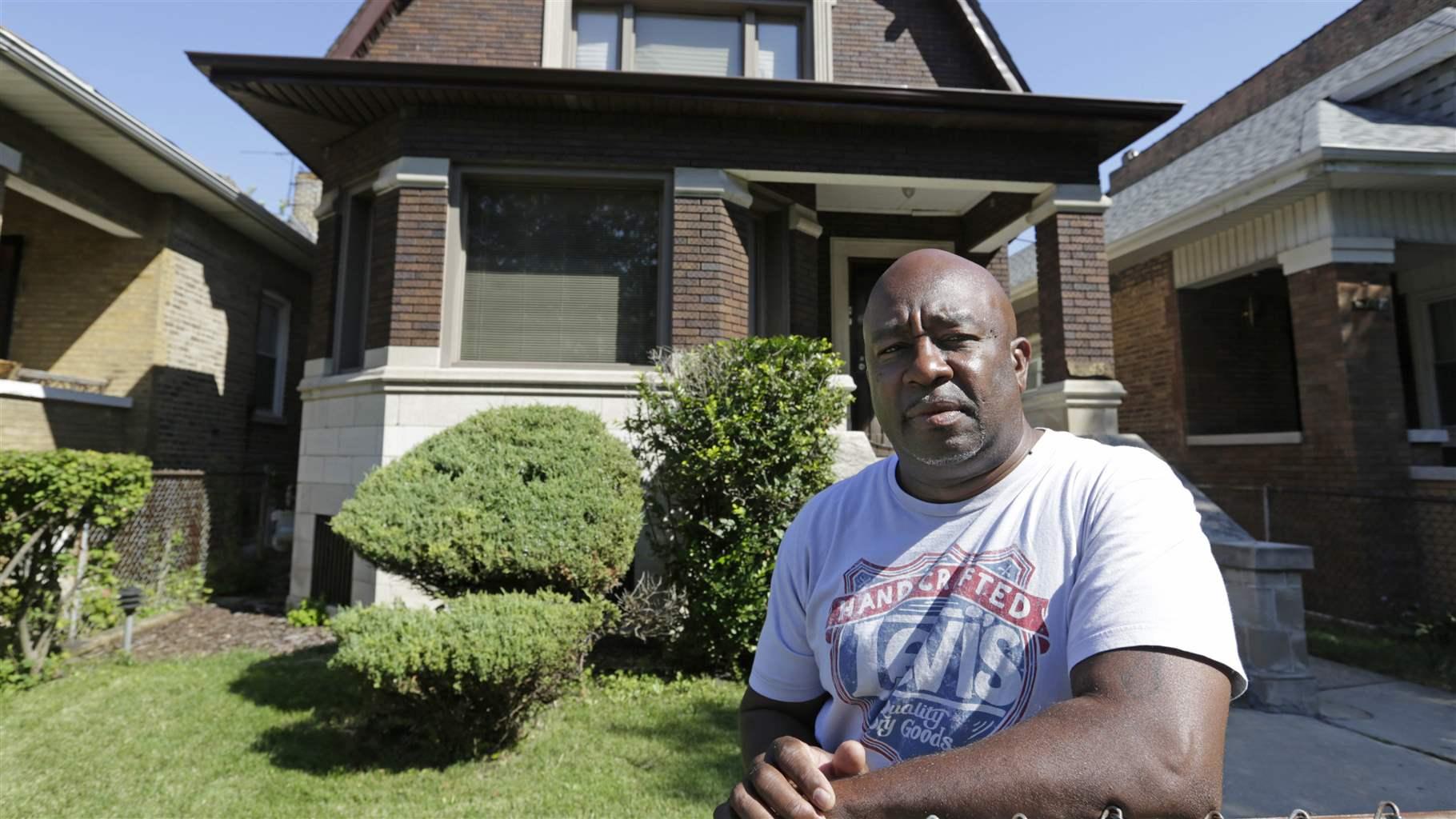
Stateline June25Chicago resident James Young stands outside his home in the Auburn Gresham neighborhood in this file photo. A Chicago Tribune report in 2017 found the city’s property tax system placed an unfair burden on poorer residents of minority communities.

A Heavier Burden

In several cities, recent newspaper investigations or audits have revealed troubling inequities in tax assessments.

In 2017, the Chicago Tribune published a series of stories on the Cook County Tax Assessor’s Office, finding that for years the county’s property tax system had given huge financial breaks to homeowners in wealthier and largely white communities while placing an unfair burden on poorer people living in minority communities.

The newspaper blamed the county assessor’s flawed system for valuing properties, not overt racism, for the disparities. The result, however, was that people living in poorer areas, many of them minorities, tended to pay more in taxes as a percentage of their home’s value than residents of more affluent areas.

In 2018, an investigation by the Philadelphia Inquirer and the Philadelphia Daily News found that homes in that city that sold for between $25,000 and $50,000 were assessed 70% higher than they should have been, inflating the tax bill for a $37,500 home by about $360 annually.

At the same time, the owners of more expensive properties got significant breaks. Homes that sold for between $1 million and $2 million were assessed at nearly 11% below their actual value, resulting in tax bills that were $2,000 less than they should have been.

A subsequent report by the city controller concurred that homeowners in Philadelphia’s lower-income, majority-minority neighborhoods “are likely paying more than their fair share of property taxes.”

In February, the Center for Municipal Finance at the University of Chicago Harris School of Public Policy released a review of property assessments in Detroit between 2016-2018, finding that the property tax burden fell disproportionately on the city’s lowest-income homeowners.STATELINE STORY October 3, 2018This City Wants to Reverse Segregation by Reviving Neighborhoods

New Orleans also has faced criticism over its property tax assessments. A March report by the Louisiana legislative auditor found that the Orleans Parish assessor failed to appraise 18% of the residential and commercial properties that it should have reappraised in the 2020 tax year, and had conducted “land-only” reappraisals of 38% of properties, instead of including the value of the building as required by state law.

The section of the city that wasn’t assessed was home to the wealthiest properties in New Orleans, said Broderick Bagert, a lead organizer with Together Louisiana, a statewide network of more than 250 religious and civic organizations that is pushing for big changes to the tax assessment process in the city.

“It means that the poorer you are, the more your property taxes have gone up relative to the value of your house,” Bagert said in an interview. “This is not just an abstract fairness question. This is a question that can impact whether people can stay in their homes and stay in the city.”

The problem extends far beyond that handful of cities, according to a report released this month by the nonprofit Washington Center for Equitable Growth. The study found that relative to market value, assessed property values are significantly higher for minority residents nationwide.

Within the same tax jurisdiction, the researchers found, Black and Hispanic residents on average bear a 10% to 13% higher property tax burden than white residents. One reason for the disparity: Minority homeowners are less likely to appeal their assessments, and less likely to win them when they do.

Intentional or Not

In an interview, Orleans Parish Assessor Erroll Williams bristled at the notion that assessments in New Orleans are unfair to minorities.

“There’s no racial disparities when it comes to the process,” Williams told Stateline, adding “I’m a Black assessor. … Fair market values are what we chase. We don’t care who owns it.”

But Carlos Avenancio-Leon, who co-authored the recent Washington Center for Equitable Growth study, said that “systemic racism doesn’t always require individual racism.”

“If your system is flawed,” said Avenancio-Leon, an assistant professor at the Indiana University Kelley School of Business, “even if it’s race-neutral, you still have systemic racism.”

Some policies designed to protect all homeowners against precipitous increases in their property taxes end up creating racial inequities, said Jared Walczak, director of state tax policy for the Tax Foundation, a Washington, D.C.-based tax policy nonprofit.

Walczak cited rules in many cities and states that cap the growth in the assessed value of a home, allowing a reassessment to full market value only when the home is sold or significantly transformed. That relieves incumbent property owners, who pay far lower effective tax rates than their neighbors who purchased homes more recently.STATELINE STORY April 11, 2018Pursuing Desegregation in the Trump Era

Partly because of the racist policies of the past, those who have lived in their homes the longest tend to be older, wealthier and whiter than more recent home buyers, he said.

“Policymakers should be aware that these policies pick winners and losers,” Walczak wrote in an email. “For everyone whose home’s assessed value is artificially low, someone else is paying more — a policy that often penalizes younger and lower-income families, and sometimes particularly people of color.”

Avenancio-Leon says assessors could significantly reduce racial disparities by basing their assessments on recent sales in smaller, more geographically precise areas. And Williams suggests that Louisiana lawmakers should write legislation capping property taxes for lower-income homeowners.

“You’ve got to protect the people who are on the low end,” Williams said.

Chicago offers a glimmer of hope, according to Aneel Chablani of the Chicago Lawyers’ Committee for Civil Rights, which represented three housing organizations in a 2017 lawsuit alleging that Cook County Assessor Joseph Berrios violated state and federal civil rights and housing laws by producing assessments that were unfair to poor and minority homeowners.

In 2019, the plaintiffs agreed to dismiss the lawsuit after Berrios’ successor, Fritz Kaegi, increased transparency and made other changes, including ordering an external audit of his office, pushing for automatic renewals of tax exemptions for older residents, and improving the appeals process. The Cook County Assessor’s Office also has begun using digital images of properties taken through aerial photography.

“I don’t want to seem like everything is rosy now,” Chablani said. “But we believe the changes will produce a more equitable assessment system.”Top State Stories 6/25Top State Stories 6/24AUTHORSTeresa Wiltz


Tesla overtakes Exxon’s market value in symbolic energy shift away from fossil fuels

Tesla is now at US $201 billion in market capitalization, with Exxon at US $185 billion

Tesla Inc.’s market value has surpassed Exxon Mobil Corp.’s in a sign that investors are increasingly betting on a global energy transition away from fossil fuels.

Elon Musk’s Tesla, now at US$201 billion in market capitalization, is surging on the billionaire founder’s optimism that his company can avoid a second-quarter loss. Exxon, which dropped to US$185 billion, is reeling from the worst crude-price crash in history. The largest oil company in the Western Hemisphere is preparing to cut some of its U.S. workforce.

Tesla also is on the verge of passing Toyota Motor Corp. to become the most valuable automaker in the world by market capitalization. The company topped Boeing Co. in March to become the most valuable industrial company in the U.S. and reached the No. 2 spot among automakers in January by passing Volkswagen AG.

Exxon is the world’s second biggest energy company after Saudi Aramco went public late last year. But even the status of Saudi Aramco as the world’s most valuable company is in danger now after Apple Inc. reduced the valuation gap to US$150 billion, down from about US$750 billion at the time of the initial public offering of the Saudi state-controlled oil giant six months ago.

Bloomberg.com